Monday, January 24, 2022

Target vs Achievement : Targets not met is a Leadership issue.

 Targets should be aspirational and realistic. There is nothing more frustrating than failing. 

Setting targets is not pure mathematics in a competitive multi-dimensional environment. It has many factors which determine its success. A Leader has to be aware of all the key factors that influence the performance. These factors have to be built-in while setting up the targets. 

Leaders need to be aware of team members who do not give their 100%. Some don't even try. Want to know why?

In my various assignments, this had been a challenge initially. Here is what I did and, it worked. 

I firmly believed in aligning the team with their targets. Alignment gives ownership. 100% of team members will go all out to achieve their targets. 

There can be various bases of setting targets among the team members, past geography performance, special events, shortfalls in the earlier period and, seasonal influence. It actually does not matter much if the targets are accepted by every team member. There can be reasons for the target not being accepted and, it primarily hovers around trust. Some ways that worked for me are : 

1. Target setting logics being built bottoms up. Here the team member could question the logic but, no individual discussions would be allowed. Usually, a top-down approach does not create excitement in the team. A bottoms-up model hardly fails.

2. At times, as a Leader, if we see a major favorable factor coming in, we must discuss the same with the team. Use it to motivate the team. Share your views and ask team members to huddle and list actionable. Provide additional logistics and resources and genuinely trust your team to deliver. 

( A telecom operator closed down in 2015 in India and, the Haryana team got aligned to do 100 X of their regular Mobile Number Portability achievements, 100% of team members did their ever best. The smallest circle in the country had the maximum share gain. Awards and accolades followed)

The key is alignment and, ownership. Do try. Have a dialogue, have a stretch. Listen and be heard. 

An aligned team always surprises with their performance. 

Saturday, January 22, 2022

Expectations - Do your team members miss their targets?

  Often during the annual performance discussions, we see gaps. While the team member feels they had a great year, the manager does not feel so. It leads to an uncomfortable discussion and, both want it to end soon. Trust is lost. The team perceives the manager as “Not fair”. Performance suffers in the following periods.

During some of my turnaround assignments, I have seen the same non-performing team deliver exceptional results by a simple change. Interested, READ ON.

Most Managers e-mail a table with targets and feel satisfied to have set the expectations for the team and its members. The team members acknowledge the same on the portal and, that's the end of expectation, setting exercise. The e-mail is archived for records and only opened during the annual performance discussions. Both the Manager and the team member have thus short-circuited the process of managing performance. 

As a Leader, many of us struggle with this challenge. I tried something different and, it worked. 

I set frequent expectation discussions as my 1'st priority. Built it into my calendar every quarter to have a One o One discussion with my team members. As a ritual, I blocked a window for each member in the 1'st week of every quarter. I used to do my preparations well in advance. E-mail the targets and achievements for the last quarter and mention any outstanding effort put in by the team member. 

The team member was aligned even before they came for the meeting. During the meeting, I listened to what the team member had to say. What were their challenges and, what worked for them? They also discussed what they would do differently in the next quarter. As a leader,  it also gave me insights on support required by the team member. These discussions also led to determining their future training needs. The team member used to leave with a lot of self-confidence, complete alignment on how his performance is measured and, OWNERSHIP. 

Four such discussions in a year made a difference and, it had no scope for surprises during these discussions. There is nothing more important than having a happy, engaged team member.

Results are bound to follow. 

Do make these discussions a ritual. Believe me, it works. 


Monday, January 17, 2022

Transformations with Trust


Conflicts are OK.


How to say NO


Be Genuine.


Leaders do share your Challenges with team.


Do we know what Data to analyse.


Don’t let the Power get into your way.


Expectation Management in teams.


Trust within Team


Lockdown Learnings


Genuine Leadership.


Restructure your role, before anyone else does it for you.


Unlearn to Learn


NICE culture must deliver results.


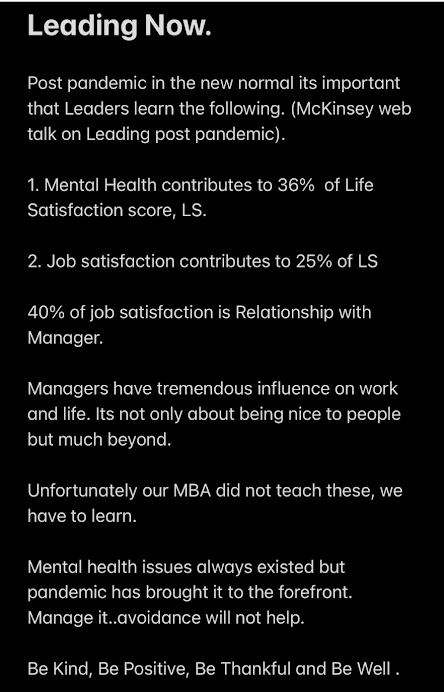
Be aware of your mental health.


Post COVID this is a reminder to Leaders. 

Sunday, April 29, 2012

Breakout Nations, By Ruchir Sharma -- book rvw


It's not just China and Brazil: from Mexico to Korea, the big beasts of tomorrow's world are already roaring.


The story hits the headlines every day. How China has become the world's second largest economy. How Tata of India has rescued Jaguar Land-Rover. How Russian money has transformed British football. And so on. It is a story of a shift of power away from the so-called advanced world to what has been dubbed the emerging world, or the BRIC countries, Goldman Sachs's acronym for the four largest such economies: Brazil, Russia, India and China.
There has even been a BRICS summit, with South Africa forming the "S". The shift has become so familiar that it is hard to remember that 20 years ago these countries played a modest role in the world economy, aside from reports about economic disasters and the need for aid relief. Now it seems likely that within another 20 years China will have passed the US to become the world's largest economy (it is already the world's largest car market) and India will have become number three. It is an astounding turnabout of fortune.
Yet we know little about it. We lump together countries that are utterly different, not just in their political systems – contrast the four
BRICs – but in the structure of their economies, their policies, and indeed their prospects. That clever acronym diverts our attention from the other powerful middle-income economies, such as Mexico, Indonesia and Turkey, and the African giant, Nigeria. What we need is a primer to guide us. That is the core contribution of Ruchir Sharma's thoughtful analysis of these nations: what they are doing, why they are different, their prospects, their achievements, their errors, and the threats they face.
He starts, as one must, with China. For anyone who has been to China recently and particularly anyone who knew it even a decade ago, the story will be a familiar one: the helter-skelter race for growth, the wealth this has brought to the new middle class, the self-confidence generated by this achievement, but also the human and environmental costs of untrammelled growth – the swagger and the squalor. But this race for growth will come to an end as China's population ages and as development reaches a natural plateau.
Sharma brings out very well the need for the country to become more "normal", with slower growth and more consumption, spreading the fruits of growth more widely. It will still become the world's largest economy but may be an easier bedfellow for the rest of us. "A slower China means a less disruptive China, producing less geographical friction, fewer trade battles, and less fear of a rising 'Red Dragon'. So perhaps this is not a bad thing."

Investors want to make a good return on their investment but they will only be able to if the country has a functioning legal system and the political stability associated with the need to see that wealth spreads down the line. So he is reasonably positive about India, bar its crony capitalism and official corruption: "no other large economy has so many stars aligned in its favour". He is more concerned about Brazil, given its bumpy record of economic management; and he is very critical of Russia, in particular the way it has failed to build a substantial middle class.
There are a series of snapshots about the other important emerging economies, in which he makes a series of sensible judgements. His gold medal goes to South Korea, the "Germany of Asia", in particular for the way it has become a manufacturing powerhouse in one generation and managed to turn adversity to advantage. In the Asian financial crisis of 1998, it had to go to the IMF for a bail-out loan. But it used this crisis to reorganise its industry, allowing many weaker companies to go under or be taken over, and by the middle of 2001 had repaid the debt. Sharma believes South Korea will manage a successful unification with the North.
He is intrigued by Africa, in particular by South Africa and Nigeria; by Turkey; by Indonesia; and by emerging Eastern Europe. These are snapshots, but thoughtful ones that enable one to calibrate ones own views and expectations.
A big message? Well, not really, because there is no magic wand that creates sustainable growth, and we should recognise that much of what is happening is catch-up. He wisely notes: "All the hottest new things, from tablet PCs to cloud computing to social networking, are emanating largely from the United States." But this is a great road-map to the new and better-balanced world in which we will all live, and an encouraging one.

Sunday, January 1, 2012

Success in 2012

My golden list to embrace success in 2012

Like to handle in 2 parts.

1. Personal. 2. Professional

Personal -- Family, self and social.

1. Spend quality time with family. Even if your work involves a lot of travel whatever time you are at home,be physically and mentally be with them. Newspaper and TV are no good. Draw a pic with your kid, thank your spouse for being there. Let them know you love them the most. Say it.

2. Self grooming is a must. Both mentally and physically. To keep up with the changing world Learn -- read books, reviews, new software. Open a cloud account. Play a game, join yoga.

3. Social life is very important. Develop friends, give back to the society. You will love it.

Professional -- Discipline, matrix, mentor.

1. Discipline is only mantra for sustainable success. Take complete ownership, do not hide behind excuses of team members inability to deliver. Drive it...get going. Be harsh on yourself for gaps in execution. You are lucky to have an opportunity to execute. Many more talented guys do not have a job. Do not loose this...opportunity to perform.

2. Data is all over the place. Know what matrix to look at. Deep dive into details to know cause and effect. Do not run blindly after any graph or chart..build your own. Recreate if you started with wrong insights.

3. Mentor at workplace helps a long way. Gives you a birds eye view. Must have.

Above all be humble, do not speak in a manner in which you would not like to be spoken. Be firm in your discussion but not arrogant.

All the best. Do share your views and success as you go along.

Saturday, December 24, 2011

Great by Choice

We can be great by choosing Discipline in execution...Leaders win by this. No longer do Leaders need to be the visionary kinds.

Discipline is key...execution requires only discipline.

First, the successful leaders were not the most "visionary" or the biggest risk-takers; instead, they tended to be more empirical and disciplined, relying on evidence over gut instinct and preferring consistent gains to blow-out winners. The successful companies were not more innovative than the control companies; indeed, they were in some cases less innovative.

Summary By ALAN MURRAY

'Great by Choice" is a sequel to Jim Collins's best-selling "Good to Great" (2001), which identified seven characteristics that enabled companies to become truly great over an extended period of time.

Mr. Collins's new book tackles the question of how to steer a company to lasting success in an environment characterized by change, uncertainty and even chaos.

Lessons of "Great by Choice" are not meant to apply to a particular moment of economic turbulence but to a continuous condition—a business world "full of rapid change and dramatic disruption."

For their study, the authors chose a set of major companies that achieved spectacular results over 15 or more years while operating in unstable environments; Messrs. Collins and Hansen call them "10Xers" for providing shareholder returns at least 10 times greater than their industry. Then the authors compared those companies—Amgen, Biomet, Intel, Microsoft, Progressive Insurance, Southwest Airlines, Stryker—to similar, but less successful, "control" companies: Genentech, Kirschner, AMD, Apple, Safeco, PSA and United States Surgical. It is an indication of the volatile nature of today's business success that, using 2002 numbers, Microsoft came out as a "10Xer" while Apple was its less successful "control" company, a ranking now reversed. More on that below.

Messrs. Collins and Hansen draw some interesting and counterintuitive conclusions from their research.First, the successful leaders were not the most "visionary" or the biggest risk-takers; instead, they tended to be more empirical and disciplined, relying on evidence over gut instinct and preferring consistent gains to blow-out winners. The successful companies were not more innovative than the control companies; indeed, they were in some cases less innovative. Rather, they managed to "scale innovation"—introducing changes gradually, then moving quickly to capitalize on those that showed promise. The successful companies weren't necessarily the most likely to adopt internal changes as a response to a changing environment. "The 10X companies changed less in reaction to their changing world than the comparison cases," the authors conclude.

Like its predecessor, "Great by Choice" is far from a dry work of social science. Mr. Collins has a way with words, not least with metaphor. A whole chapter is devoted to pursuing a "bullets-then-cannonballs" approach to competition. The book's organizing metaphor is built around the story of Roald Amundsen and Robert Falcon Scott, the two men who set out separately, in October 1911, to become the first explorers to reach the South Pole. Amundsen won the race by setting ambitious goals for each day's progress but also by being careful not to overshoot on good days or undershoot on bad ones, a disciplined approach shared by the 10Xers, according to Messrs. Collins and Hansen. Scott, by contrast, overreached on the good days and fell apart on the bad, mirroring the control companies in "Great by Choice."

The authors find Amundsen-style discipline in Peter Lewis of Progressive Insurance, who refused to play the analysts' game of "predicting" quarterly earnings and made Progressive the first SEC-company to publish monthly financial statements so that analysts could follow actual results instead. Another disciplined leader is Andy Grove, who was willing to take decisive action at Intel, such as abandoning the business of memory chips in 1985, but only after immersing himself thoroughly in the evidence of a changed marketplace. Herb Kelleher of Southwest Airlines, the authors say, was always preparing for the next recession even when none was in sight.

If "Great by Choice" shares the qualities that made "Good to Great" so popular, it also shares some that drew criticism. The authors' conclusions sometimes feel like the claims of a well-written horoscope—so broadly stated that they are hard to disprove. Their 10X leaders are both "disciplined" and "creative," "prudent" and "bold"; they go fast when they must but slow when they can; they are consistent but open to change. This encompassing approach allows the authors to fit pretty much any leader who achieves 10X performance into their analysis. Would it ever be possible, one wonders, to find a leader whose success contradicted their thesis?

Which brings us back to Apple. Messrs. Collins and Hansen had no way of knowing, when they began sifting through their data in 2002, that Apple would become one of the most stunning turnaround stories in business history, soaring past Microsoft in market value. The late Steve Jobs accomplished that turnaround with a run of boldness, innovation, visionary thinking and egotism that might seem counter to the studied conclusions of "Great by Choice" as well as those of "Good to Great," in which Mr. Collins found that one of the leading attributes of the best business leaders was "humility." Steve Jobs?

But Messrs. Collins and Hansen have no trouble fitting Mr. Jobs into their framework. They write that his first task in getting Apple back on track was "not iTunes, not the iPhone, not the iPad"—i.e., not an act of innovative brilliance. Instead, "he increased discipline. That's right, discipline, for without discipline there'd be no chance to do creative work." A veritable Amundsen.

Mr. Murray is deputy managing editor of the Journal and the author of "The Wall Street Journal Essential Guide to Management."